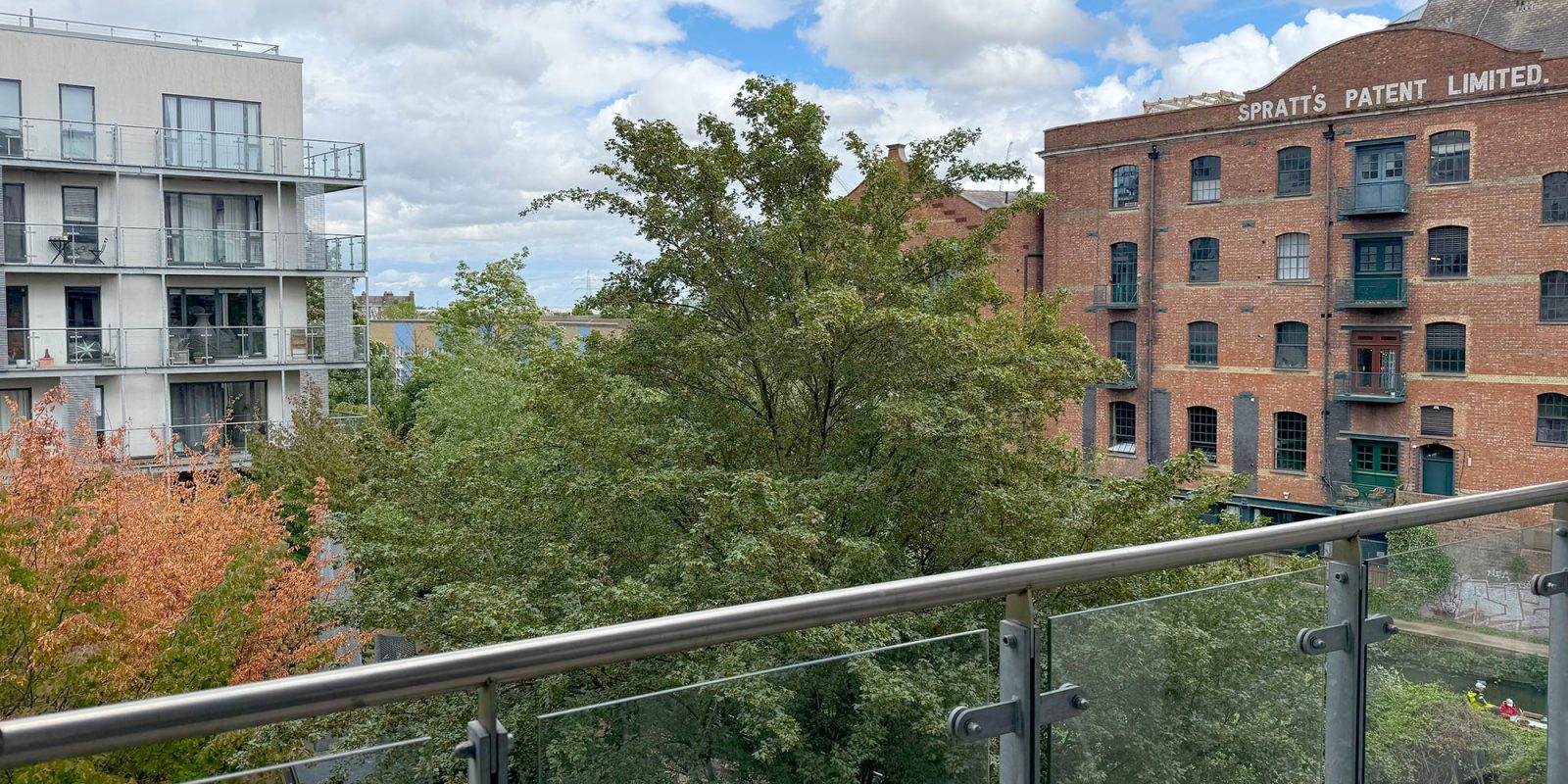
I’ve recently completed what must be a strong contender for the longest-running saga in selling one home and buying another. I won’t bore you with the details, but the entire process from start to finish was two years almost exactly to the day. I have sadly sacrificed my former spectacular city view but let’s just say it was a good move.
I set an ambitious target of a fortnight for completing all the main home improvement work on my new apartment, and so far seem to be getting pretty close. This includes much of my new smart home setup …
As the smart home kit was part of the sales pitch of my previous apartment, I left it all behind, meaning I’d be starting again from scratch. It was in February that I dared to imagine it might actually soon be happening and to give some thought to what I wanted in my new home.
I was already thinking about my upcoming smart home setup back in September of last year. In particular, two mistakes I wouldn’t make again.
Curtains
One of these was floor-to-ceiling smart home blinds, and this time around I’ve opted for a softer look by switching to linen blackout curtains. I’ll be trying a SwitchBot setup to see how well it works, as I do like automated blinds or curtains gently letting in light in the bedroom when it’s time to wake, but first I need curtain rods!
‘Magic tap’
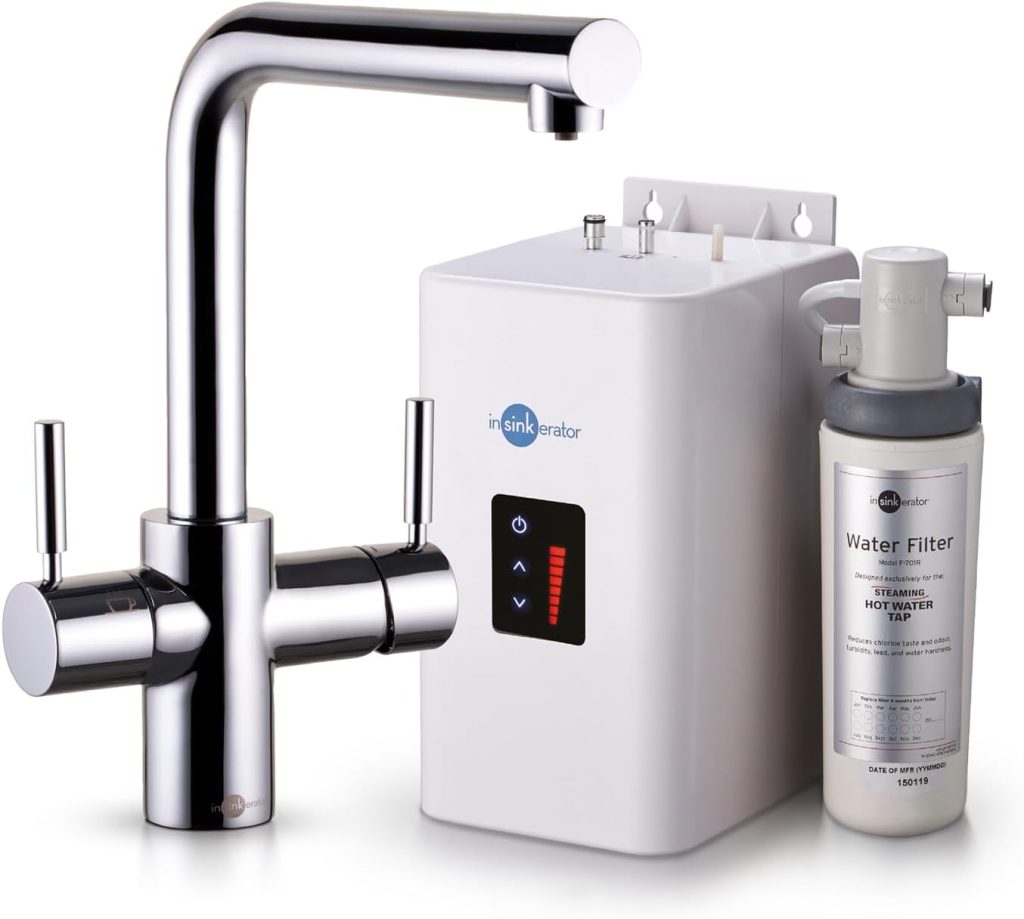
I’m a Brit and therefore almost entirely powered by tea. There are of course smart kettles, but who’s got the time for that? In my previous two places, I’ve installed a tap and boiler system that provides instant boiling water on demand.
This isn’t technically smart technology at all, but it was one of my top priorities when it came to installing new devices. The system is mostly installed, but a complication with the plumbing means that the boiling water system isn’t yet fully hooked up, hence the rather oddly positioned kettle you’ll see in the photo below.
Original HomePods
My new apartment is smaller than my old one, but I’m still using all but one of the original HomePods. With my desk now part of the living room, I’ve opted for a triangular setup. This provides two speakers on cupboards opposite the sofa and a third one on my desk. This provides a surround sound experience no matter where you’re sitting in the room.
Hue Gradient lighting
I’ve said before that color lighting seems to be one of the most polarizing elements in smart home setups. Some view mood lighting as a key benefit of the tech, while others dismiss it as a gimmick.
Personally, I do stick to warm white lighting most of the time, but there are occasions when I really appreciate mood lighting and so always opt for color-capable lights.
I’ve long been a fan of Hue light strips, but while these were previously limited to displaying a single color at a time, the latest Gradient models offer multi-colors along their length. This is more expensive but obviously makes them massively more flexible. I’ve opted for one of these, which sits beneath storage units along one of the walls of the room.
The doors have yet to be attached to the cupboards, but you can see here what they will look like when finished.
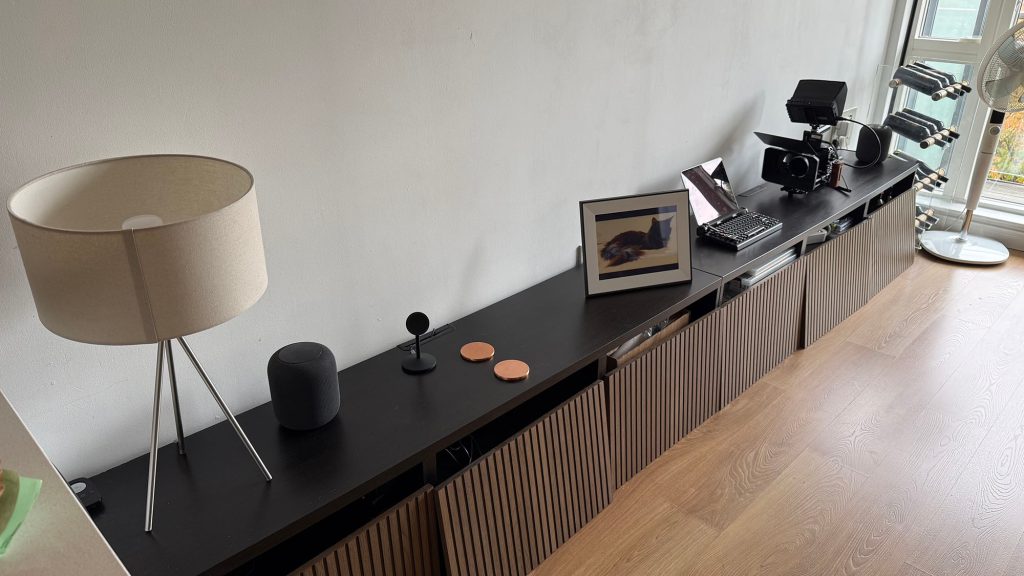
I was initially planning to fit a diffuser strip to remove the hotspots from the light strip, but given the vertical stripe design of the cupboard doors, I actually think the similar reflected light effect (clearer in the pink lighting shot) matches this look rather well, so I may leave this as is.
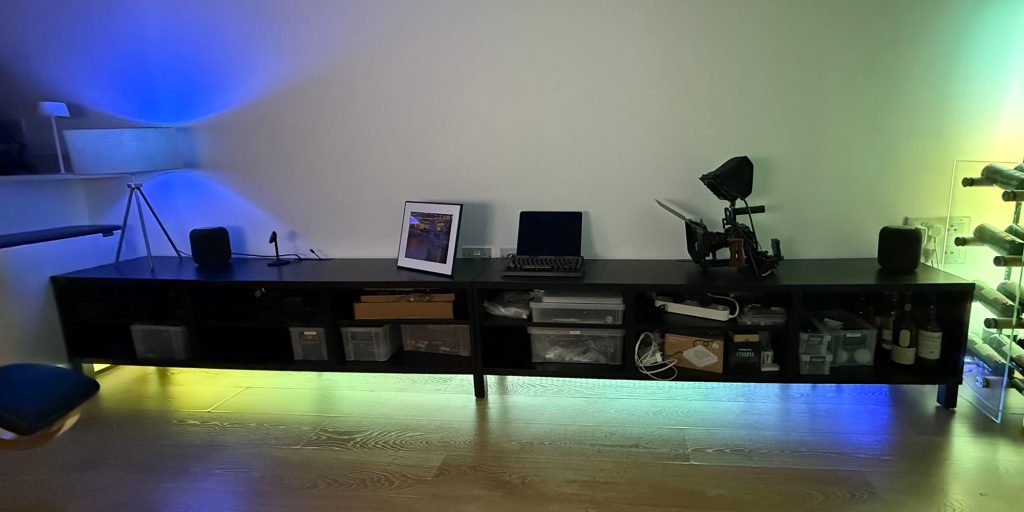
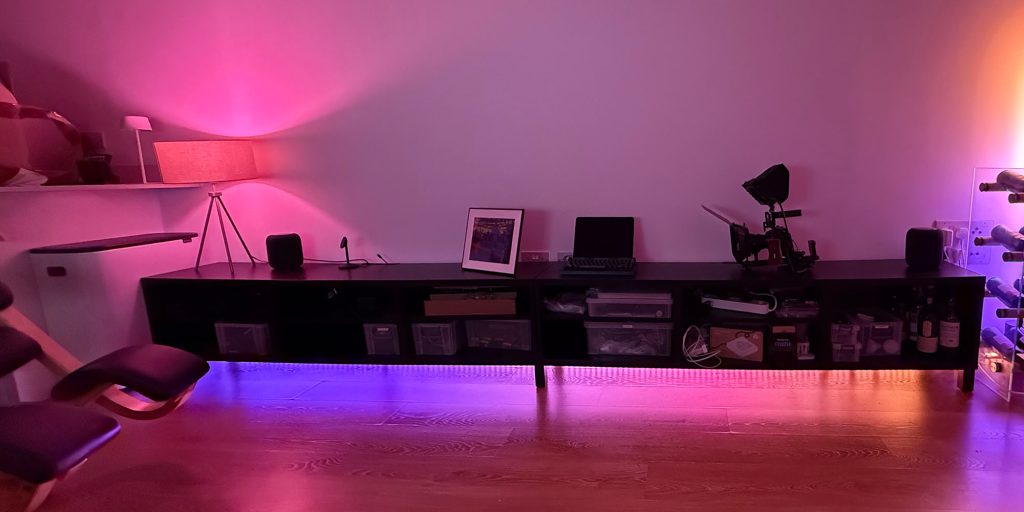
On the right, I’m using a Philips Hue Signature Gradient smart floor light. This provides the same multicolor capabilities in a vertical format. You need to be careful when ordering one of these, as there is an older non-Gradient model around. If you see a price below $200, be suspicious.
Finally, there’s a table lamp with a standard color ambiance light bulb. I mostly keep this to warm white, but it can be included in color scenes when desired.
I previously had a Hue light strip along the back edge of the desk, providing some indirect mood lighting for that. However, the plan here is to have DIY wood panelling running up the section of the wall behind the desk. You can see here the matte black paint that will form the background for the wood strips. The combination of black paint and dark wood isn’t likely to reflect much light, so I probably won’t do this.
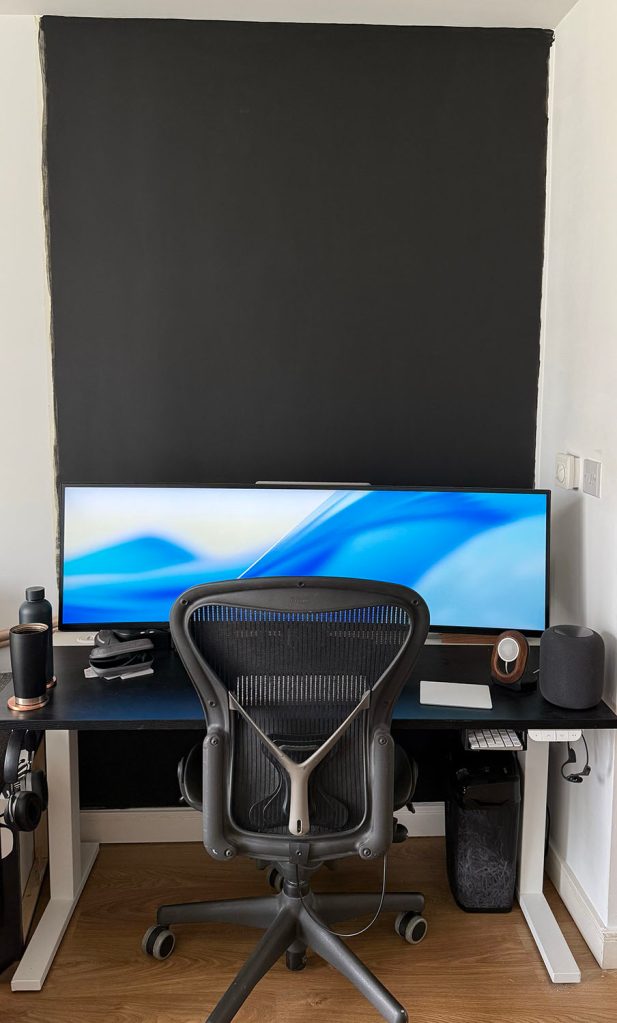
(Before we get panicked comments, I should stress that the masking tape is still in place, hence the apparent uneven edges.)
I’m still in the process of creating the bedroom, so not yet sure exactly what lighting I will use in there.
Smart lighting uber-practical in the kitchen
I previously had Hue light strips beneath the cabinets in my kitchen, and although these were color ones, I almost never used that capability. This time around I wasn’t even sure I was going to bother with smart lighting in the kitchen, but there turned out to be a very practical reason for doing so: the kitchen light switch (bottom left) is not in the kitchen!
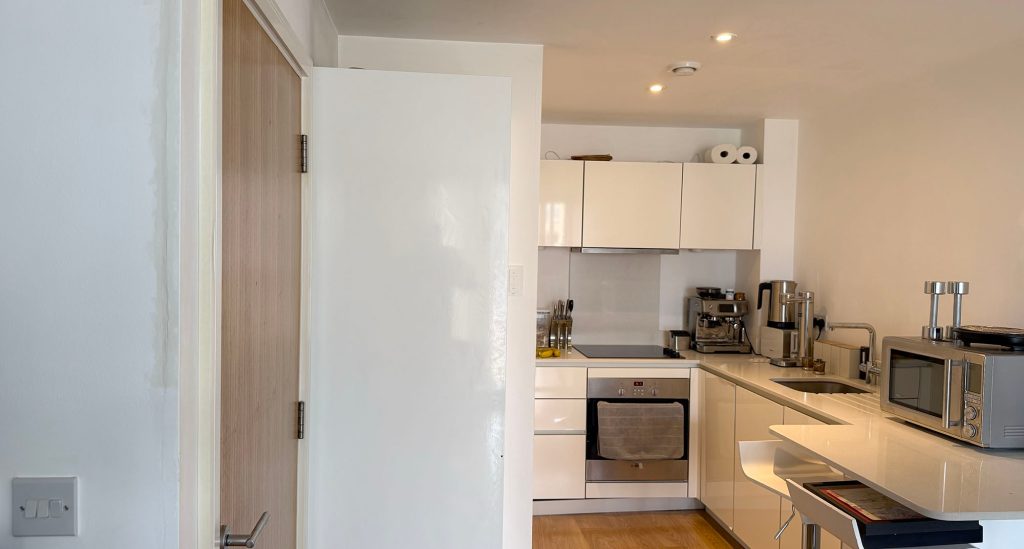
I’ve fixed this by putting a Hue switch in the kitchen. (And yes, there are still a few things out of place, and walls waiting to be repainted after filling various imperfections.)
Presence detectors
My previous Hue kitchen light switch was very rarely used as I had a motion detector to switch on the lights whenever anyone walked into the kitchen. I’ll be doing the same again here, but as the technology has now moved on, I’ll be using a presence detector in place of a motion detector.
The main benefit these offer is that motion detectors aren’t good at detecting the fact that someone is still present in the room unless they are moving, while presence detectors claim to be good at this. This will be particularly useful in the bathroom where the lights had a habit of turning off when you were relaxing in the bath.
Smart Lock
Smart locks can be somewhat complicated in the UK due to the fairly wide variety of different physical lock designs in use. I’ll need to do some research on compatibility, but my top priority here is Apple Key support.
Other
I don’t have anything to add to my previous comments about smart switches, smart plugs, robot vacuum and Apple TV. I’ll write future pieces as my smart home plans unfold, and likely provide a video tour once everything is complete.
FTC: We use income earning auto affiliate links. More.